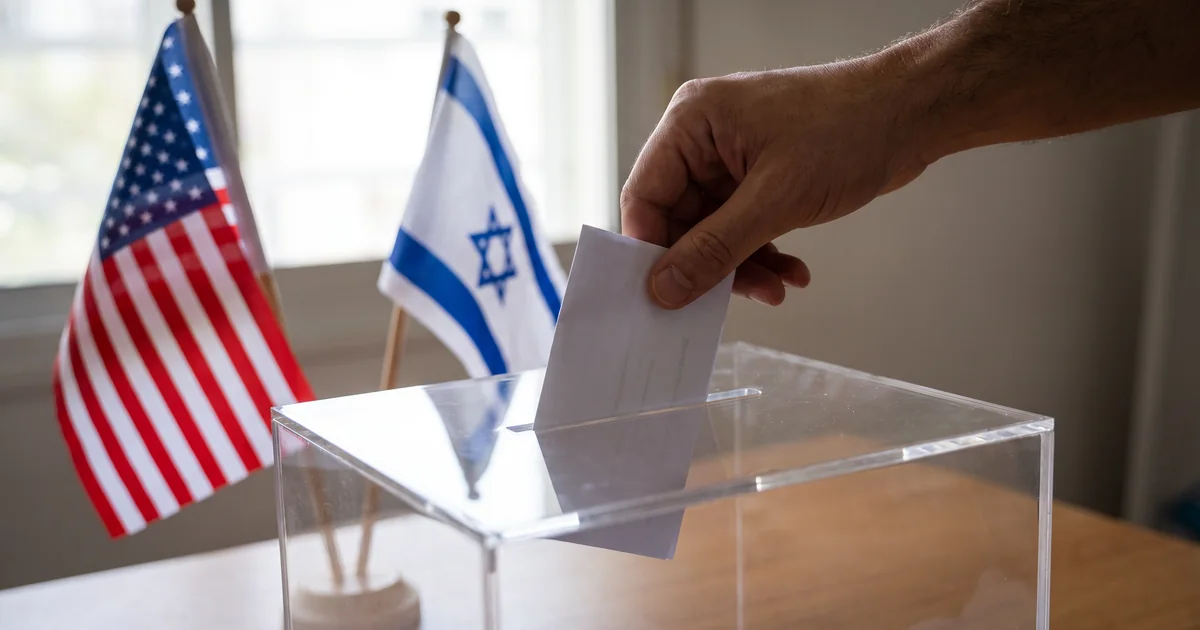
Within one week, the two governments that began the strikes on Iran on 28 February both lost ground at home. In Israel's election on 27 October, Prime Minister Benjamin Netanyahu's coalition fell from 64 seats to 53, short of the 61 needed to govern. In the US midterm elections on 3 November, Democrats won control of both the House of Representatives and the Senate, according to projections by CBS News, CNN, NBC News, CNBC and The Washington Post. Neither result ends the regional conflict. Both make a long new campaign harder to sustain, and the next eight weeks are likely to bring both the most diplomacy and the most risk. Below is what changed, and what our data says about Dubai property in each case.
The US result: Democrats take Congress
- Senate: Democrats are projected to hold at least 51 of the 100 seats (CNN, CNBC). The Associated Press projected Democrats winning seats held by Republicans in Iowa, Kansas, North Carolina, Ohio, South Carolina and Texas. CBS News also projected a Democratic win in Maine, where Troy Jackson beat Senator Susan Collins.
- House: CNBC's election desk projected at least 245 of the 435 seats for Democrats; 218 are needed for control. Some races were still being counted on election night. Hakeem Jeffries is in line to become Speaker.
- Why voters moved: CBS News exit polls put President Donald Trump's approval at 38%, with about three in four voters dissatisfied with the direction of the country. Laurel Rapp of Chatham House told CNBC the Iran conflict was a "major issue" in the vote, alongside high fuel and food prices.
- Trump's response: He told The New York Times he is "absolutely willing to accept those results", said he could work with Democrats on immigration, and signalled that he would use his veto often.
The new Congress takes its seats on 3 January 2027. Until then, the current Republican-led Congress stays in place. President Trump's term runs to January 2029.
What a Democratic Congress means for Trump's decisions
"The election changes the Congress; it does not change the president," J.C. Lintzenich of the German Marshall Fund told CNBC. A US president keeps wide authority over foreign policy and military action. What Congress holds is money, oversight and appointments:
- Spending. From January, any new or longer campaign against Iran needs funding that a Democratic House must pass. Holger Schmieding, chief economist at Berenberg, told CNBC that Congress is unlikely to fund another costly campaign like the one that began in February.
- Votes to limit military action. Rapp expects Democrats to bring House and Senate votes to end US involvement, but whether such votes bind the administration "is another matter". The president can veto them, and overturning a veto takes two-thirds of both chambers, which Democrats do not have.
- Oversight. House committees gain the power to subpoena officials and documents, and Democrats have said they will use it.
- Appointments. A Democratic Senate can hold up the president's nominees and use them as leverage on Iran policy, as Fortune and Punchbowl News have reported.
In Rapp's words, the president is "somewhat constrained" but "on foreign policy, he does still retain a lot of latitude". This is why the period until 3 January matters. The Wall Street Journal and The New York Times have reported that Washington prepared options for renewed strikes after the midterms. The AP reported that Netanyahu pressed for a wider air campaign after 3 November, and that the president had not decided. At the same time, Qatar, mediating together with Pakistan, said on 3 November that it was "hopeful" of an "interim deal": Iran would stop attacks on shipping in the Strait of Hormuz and the US would lift its blockade of Iranian ports. Trump said on 2 November that a deal "could happen". Schmieding's own forecast is a final round of strikes, followed by a deal that reopens the Strait by 2027.
Tehran read the result as a message. Iran's parliament speaker, Mohammad Bagher Ghalibaf, said American voters had rejected the conflict and that Iran endorsed that message.
Israel: Netanyahu's coalition loses its majority
| Israel, 27 October 2026 | Seats (of 120) |
|---|---|
| Netanyahu's coalition (Likud 27, United Torah Judaism 7, Otzma Yehudit 7, Shas 6, Religious Zionism 6) | 53 (64 after the 2022 election) |
| Opposition led by Gadi Eisenkot (Yashar 21, Together 12, The Democrats 8, Yisrael Beiteinu 7) | 48 |
| Arab-led parties (Joint List 11, Ra'am 8) | 19 |
| Needed to form a government | 61 |
Likud is still the largest party, with 27 seats, 9 fewer than in 2022. Gadi Eisenkot, a former chief of the Israeli military, leads Yashar, a new party that won 21 seats. Turnout was 77.9%, the highest in decades.
What happens next. The official results go to President Isaac Herzog on 4 November, and the new Knesset is sworn in on 10 November. Herzog then asks one member to form a government. That member has 28 days, which can be extended by 14. If they fail, a second member can try. If nobody succeeds, Israel holds a new election within 90 days. Herzog has said he will press for a unity government. The other options discussed are a rotation deal between two prime ministers, or a minority government supported from outside.
Netanyahu stays in office as caretaker until then. A caretaker government has "the same powers as a regular government", Guy Lurie of the Israel Democracy Institute told Reuters, together with a duty of restraint. Israel's Supreme Court has said a caretaker government should avoid far-reaching decisions unless they are pressing. Or Asher of the Tachlith Institute told Reuters that security is "the clearest exception" to that restraint: a caretaker prime minister can legally order military action, including against Iran. He added that oversight by parliament is "at its thinnest in the weeks after the new Knesset convenes".
What it means for Israel's Iran policy
- Netanyahu's course so far: a hard line on Iran, and pressure on Washington for a wider joint campaign. Commentators, among them Fred Kaplan in Slate, expect that he would not resume large-scale strikes without at least a green light from President Trump. That green light now comes from a president facing a Democratic Congress in January.
- Eisenkot's position: he has dismissed regime change in Iran as a "fantasy", and prefers economic pressure to change Tehran's conduct on nuclear weapons and the armed groups it backs. He would be unlikely to oppose a response if Iran struck Israel. He has also said Netanyahu might use security for political ends, a claim Netanyahu's office rejects.
- What does not change: analysts expect no fundamental reversal of Israel's position on Iran's nuclear programme and missiles, whoever governs. What can change is the goal and the appetite. A unity government that includes Eisenkot would be less likely to pursue an open-ended campaign aimed at regime change, and more likely to lean on pressure and diplomacy. That last point is our reading of the positions above, not a stated policy.
Stability in the region: the next eight weeks decide a lot
Both leaders who began the 28 February campaign now face tighter limits at home: President Trump from 3 January, and Netanyahu as soon as a new government forms. Over the coming months, that pushes the conflict in the direction of a negotiated outcome. In the short term, both outcomes are possible. A Congress that sits until 3 January and a caretaker government in Israel are, according to the reporting above, the window in which renewed strikes were being prepared, and also the window in which Qatar's interim deal could be signed.
The region is not calm yet. In October, the UK's maritime security office (UKMTO) recorded 30 attacks on commercial ships, a record. On 2 November, US forces carried out what officials called "limited defensive strikes" on Iran's Qeshm Island, after a US aircraft was fired on. Oil shows the market's reading: Brent crude fell 7.6% on 2 November to USD 104.77 a barrel on hopes of a deal, and settled at USD 103.60 on 3 November. It has moved between roughly USD 70 and USD 120 since February.
| Key dates | |
|---|---|
| 28 Feb 2026 | The US and Israel strike Iran; Iran strikes Israel and Gulf states, the UAE among them |
| 8 Apr | Two-week ceasefire |
| 17 Jun | The US and Iran sign the Islamabad memorandum: the ceasefire is extended by 60 days, the Strait is to reopen and the US blockade is lifted |
| 8 Jul | The memorandum breaks down after attacks on ships in the Strait |
| August | Iran closes the Strait of Hormuz to foreign shipping |
| 27 Oct | Israel votes; Netanyahu's coalition wins 53 of the 61 seats it needs |
| 2–3 Nov | US strikes on Qeshm Island; Qatar "hopeful" of an interim deal; Americans vote |
| 10 Nov | The new Knesset is sworn in |
| 3 Jan 2027 | The new US Congress takes office |
What stability would mean for Dubai property
The numbers below are registered Dubai sales to 30 October 2026. October is complete: sales are registered Monday to Friday only, and 31 October was a Saturday. Apartments and villas are counted separately, and off-plan is never mixed with ready. Prices are averages.
1. Prices held through the conflict.
| October | Sales Oct 2025 | Sales Oct 2026 | Change | Average price Oct 2025 | Average price Oct 2026 | Change |
|---|---|---|---|---|---|---|
| Ready apartments | 3,884 | 2,787 | −28.2% | AED 1,586/sqft (AED 17,072/m²) | AED 1,594/sqft (AED 17,158/m²) | +0.5% |
| Ready villas and townhouses (per plot area) | 684 | 459 | −32.9% | AED 1,598/sqft (AED 17,201/m²) | AED 1,614/sqft (AED 17,373/m²) | +1.0% |
| Off-plan apartments | 11,735 | 5,524 | −52.9% | AED 2,058/sqft (AED 22,152/m²) | AED 1,950/sqft (AED 20,990/m²) | −5.2% |
| Off-plan villas and townhouses (per plot area) | 843 | 566 | −32.9% | AED 1,765/sqft (AED 18,998/m²) | AED 2,072/sqft (AED 22,303/m²) | +17.4% |
A ready apartment or villa in Dubai cost about the same per square foot this October as last October. Part of the lower off-plan apartment average is a change in what was bought: buyers moved to smaller flats in newer, lower-priced communities. The off-plan villa average follows which projects sell in a given month, and few do, so its +17.4% is not a price rise. For villas, the registry measures the plot, so compare villa prices with other villas only.
2. What fell is the number of sales. Dubai registered 9,336 apartment and villa sales in October 2026, against 17,146 in October 2025 (−45.5%). Their value was AED 19.27 billion, against AED 37.44 billion (−48.5%). The market is waiting more than it is selling cheaper.
3. Sales follow the region's temperature, and the last calm showed how fast they react.
| Registered sales, 2026 | May | Jun | Jul | Aug | Sep | Oct |
|---|---|---|---|---|---|---|
| Ready apartments | 1,776 | 2,246 | 2,547 | 2,338 | 2,345 | 2,787 |
| Ready villas and townhouses | 297 | 393 | 464 | 405 | 439 | 459 |
| Off-plan apartments | 6,388 | 8,541 | 8,533 | 7,279 | 6,292 | 5,524 |
| Off-plan villas and townhouses | 330 | 399 | 348 | 375 | 458 | 566 |
In June, the month of the Islamabad memorandum, off-plan apartment sales rose 33.7% on May, ready apartment sales rose 26.5% and ready villa sales 32.3% (May was also shortened by the Eid al-Adha holiday). After the memorandum broke down on 8 July, off-plan apartment sales fell every month, to 5,524 in October, 35.3% below July. Ready homes kept going. October's 2,787 ready apartment sales were the most since February, and 18.8% more than in September.
4. If the region settles, here is what we would expect, based on the pattern above.
- The number of sales comes back first, and prices follow. Prices did not need rescuing. The backlog is in deals: buyers who waited.
- Off-plan leads. It is the segment that rose most in June and fell most after July. A calmer region also lets developers bring back the launches they held back this year.
- Ready homes add to a recovery that has already started. Ready apartment sales rose for two months in a row before either election.
- Prices stay steady rather than jump. Our base case is still the one in our Dubai property market prediction 2026–2027: a steady market, with new off-plan launches priced up by building costs (Dubai's construction cost index was +10.8% year on year in the second quarter of 2026).
5. If it does not settle, the months since July are the guide. Ready prices held steady, and ready sales rose, while the region heated up again. The main effect was fewer off-plan sales.
The dxbpropy take
The two elections reduce the political room for a long new campaign against Iran, in Washington from January and in Israel once a government forms. They do not settle the conflict. Three dates to watch: Qatar's answer on the interim deal, the new Knesset on 10 November, and the new Congress on 3 January. For buyers, today's market has steady prices, fewer competing buyers and more choice. If a deal comes, June showed how quickly that can change, above all for off-plan launches.
Want the numbers for your area or building? Ask dxbpropy.ai what prices and sales did through the conflict and since, by community, building and bedroom count, built on official Dubai Land Department records plus 200 million+ market datapoints, growing daily.
Election figures are projections and final counts published by 4 November 2026; some US seat counts may still change. Sources: CBS News, CNN, NBC News, CNBC, The Washington Post, The Associated Press, The New York Times, The Wall Street Journal, Fortune, Punchbowl News, Chatham House, Berenberg, German Marshall Fund (US election and analysis); Israel's Central Elections Committee via The Times of Israel, Al Jazeera, NPR, Reuters, Israel Democracy Institute, Tachlith Institute, Slate (Israel); UKMTO, CBS News, CNBC (shipping and oil); Dubai Land Department registered sales to 30 October 2026 (Dubai figures); Dubai Statistics Center (construction costs). Not financial advice.